
Sumitomo Rubber Industries (SRI) and Fujitsu Limited announced that they have jointly developed a technology, an AI surrogate model, to predict tyre performance with high accuracy and in a short time using AI, confirming its effectiveness in a recent proof of concept. This technology, developed as part of SRI’s long-term management strategy for design digital transformation, was applied to the structural analysis of tyre deformation when in contact with the road surface. As a result, the analysis time was significantly reduced by approximately 90% from about 45 minutes to about 5 minutes, while achieving analysis of approximately 600,000 elements (meshes).
Based on the results of this proof of concept, both companies will proceed with the development of a design support tool for tyre design, aiming for its practical implementation at SRI’s brand Dunlop by April 2027, to accelerate data-driven development and swiftly supply high-quality tyres with enhanced safety and environmental performance to the market.
This technology is designed to run on Fujitsu-Monaka a next-generation Arm-based CPU developed by Fujitsu that pursues both high performance and energy efficiency.
In manufacturing, CAE (Computer Aided Engineering) analysis, which simulates the behaviour of products and structures to evaluate performance and safety, requires a substantial amount of computational time due to the increasing performance and complexity of products.
In tyre design, FEM (Finite Element Method) analysis, a type of CAE analysis, is commonly used. While increasing the number of elements by refining the mesh improves accuracy, it also increases computation time and associated development costs, necessitating a balance between accuracy and computational load. Furthermore, analysis requires specialized knowledge, and securing skilled engineers is also a challenge.
To address these issues, both companies developed an AI surrogate model that rapidly predicts solutions to the governing equations of FEM using accumulated FEM analysis results as training data.
Leveraging Dunlop’s tyre design expertise and actual design data, along with Fujitsu’s AI technology, both companies jointly developed an AI surrogate model based on the Graph Neural Network (GNN) algorithm. They conducted a proof of concept for tyre structural analysis, focusing on evaluating deformation behaviour and contact characteristics such as contact shape and pressure distribution when a tyre is in contact with the road surface.
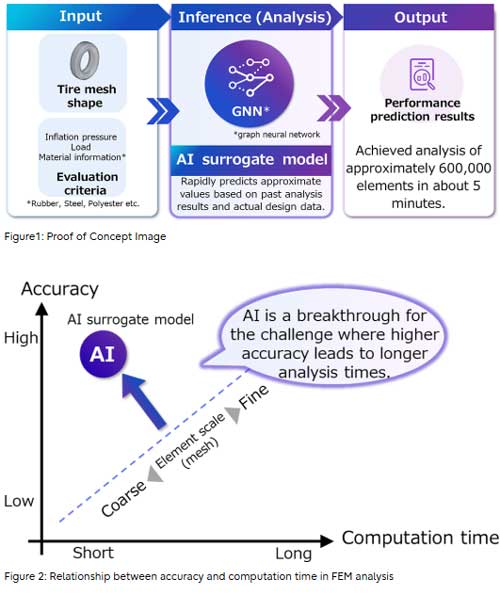
As a result, computation time for the analysis was reduced from approximately 45 minutes to about 5 minutes. The technology predicted the contact shape between the tyre and the road surface with a high average accuracy of 87.7% compared to FEM analysis. This technology will enable faster decision-making and optimise costs, in addition to improving performance, by allowing the determination of tire structure and material specifications in fewer processes and a shorter time, which previously required multiple design processes.
Both companies will begin verification of this AI surrogate model by December 2026, aiming to optimise inference speed and power efficiency. They will also expand the application range of tyre structural analysis and develop a design and development support tool that can be directly used by designers without specialised knowledge with commercialisation by April 2027.