
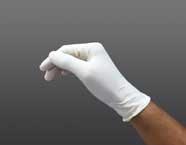
With disposable nitrile rubber gloves being produced in millions each year, with most used only once before being discarded, there is a growing interest in their end of life use.
As such, researchers at Aarhus University in Denmark have demonstrated a method for transforming waste rubber gloves into a solid adsorbent capable of repeatedly capturing carbon dioxide.
The concept aims to repurpose a difficult waste product as a tool for emissions reduction. Simon Kildahl, a postdoctoral researcher at Aarhus University, and his colleagues report that nitrile rubber can be chemically converted into a CO2?capture material. He notes that the approach could have significant impact because so much of the material currently ends up being incinerated.
“A plastic bottle can be recycled relatively easily, as we know from deposit-return systems,” Kildahl said. “But other plastic materials are problematic because they cannot be reused in the same way. Therefore, they often end up being burned, which is currently the case for rubber gloves.”
“In our experiments, we converted the glove so that it could capture CO2 instead of becoming a waste product that releases CO2 and other harmful gases during incineration.”
Kildahl works within the Skydstrup Group under the Novo Nordisk Foundation CO2 Research Centre (CORC), a collaboration focused on technologies that capture or convert carbon dioxide. The team has previously explored ways to recover value from other hard?to?recycle materials, including polyurethane foam from mattresses and components from wind turbine blades.
The process begins by shredding the gloves into small pieces. The material is then reacted with a ruthenium?based catalyst and hydrogen gas, altering its chemical structure so it can adsorb CO2 from simulated flue gas. According to the researchers, a real?world application could take place at power plants.
After capturing CO2, the material can be heated to release the gas for underground storage or use in Power?to?X processes. The heating step regenerates the glove?based material, allowing it to capture new CO2 in multiple cycles.
While CO2?capture technologies exist, many rely on newly manufactured materials that require fossil?based feedstocks. Kildahl’s team highlights that using a waste product avoids adding new fossil inputs to the system.
The work remains in early stages. The team reports its progress as Technology Readiness Level three or four, operating at a gram scale in the lab. Scaling to kilogram?level production will require solving challenges involving heat transfer, mixing, and cost.
Cost is another obstacle, as the method currently relies on an expensive catalyst. Any commercial pathway would require a cheaper catalyst, improved recycling, or a redesigned process that uses far less.