Innovative rubber tyres are entering the era of space missions: as a catalyst to advancing science and mobility technology on Earth and beyond, says Angelica Buan in this article.
Rubber tyre’s cosmic journey
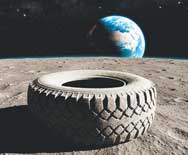
Space exploration is making history with landmark events, while the use of rubber in tyres contributes to humankind’s broader knowledge of the infinite expanse of space.
As recounted in the National Aeronautics and Space Administration (NASA) Glenn Research Centre’s Reinventing the Wheel article, the transporter of the Apollo 14 mission in 1971 was as one of the earliest applications of rubber tyres in space exploration.
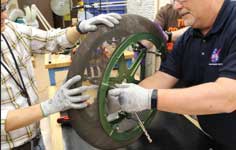
Manufactured by US tyre maker Goodyear Tire & Rubber Company the tyres featured nitrogen-filled inner tubes and were designed to facilitate pulling the cart through soft lunar soil and over rocks.
Partnership for lunar mobility
In 2022, Goodyear announced a partnership with aerospace firm Lockheed Martin to commercialise lunar mobility. The vehicles, which operate either autonomously or with astronauts, are part of NASA’s Artemis programme.
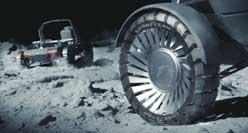
Goodyear has adapted its advanced airless tyre technology, currently used for micro-mobility and autonomous vehicles, to handle the moon’s extreme conditions, where temperatures range from -250°F at night to more than 250°F during the day.
Testing was carried out using lunar soil simulants and the collaboration delivered the first vehicle for NASA’s 2025 mission.
Tyres to the Moon and back
Tyres for spacecraft are engineered to handle extreme conditions, from high-speed landings to sharp temperature changes. Built with specialised rubber compounds and reinforced structures, they provide durability, stability, and performance for vehicles returning from space or operating on other planetary surfaces.
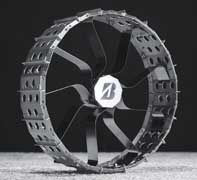
Among the recent developments, Japanese lunar exploration company ispace and tyre maker Bridgestone Corporation have tied up to develop tyres for small and medium-sized lunar rovers. Bridgestone has been developing lunar tyres using its AirFree technology to meet the stringent lunar durability and traversability requirements.
Under the agreement, both companies will work to enhance the performance of ispace’s small and medium-sized lunar rover prototypes. Bridgestone’s tyres, designed to flex and absorb shocks, will be tested on Earth before deployment on the moon. The collaboration will evaluate the feasibility of these technologies and potential business opportunities, with practical application targeted around 2029.
Bridgestone added that it started its R&D on lunar rover tyres in 2019, unveiling lightweight concept models in April 2025. Its thin metal spoke design allows flexible deformation, shock absorption, and reliable traversal over lunar terrain, including rocks.
Technology for lunar tyre development
On a similar quest, French tyremaker Michelin, as part of the Moon Reusable Autonomous Crewed Exploration Rover (RACER) team, has been awarded the phase 1 feasibility study for the Artemis project, which involves designing a lunar vehicle capable of operating in extreme conditions on the moon for ten years.
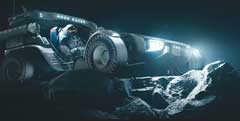
The team, led by Intuitive Machines, a US space exploration company, secured US$30 million to conduct an assessment, ushering the company’s entry into human spaceflight operations under NASA’s US$4.6 billion LTV services project.
A key partner in the project, Michelin will leverage its expertise in airless technology and advanced materials to design lunar wheels capable of withstanding extreme temperatures, solar and cosmic radiation, and loose lunar soil, ensuring maximum traction and durability. The company conveyed that the technical innovations developed for the moon could also advance terrestrial mobility applications.
The team also includes AVL, Boeing, and Northrop Grumman, contributing expertise in drivetrain, vehicle systems, and mission planning.
New horizons in Mars mobility
From Galileo Galilei’s first telescopic observation of Mars, to the early flyby attempts of the 1960s, and the several missions that followed from major space agencies, Mars wayfaring has advanced significantly. Spacecraft and rovers are now built to withstand the planet’s freezing temperatures, intense solar radiation, corrosive salts and noxious dusts.
Vehicle tyres are engineered differently for space exploration. Using rubber for rover wheels and tracks has proven extremely difficult due to the planet’s harsh daily temperature changes of 50–100°C and an atmosphere 150 times thinner than Earth’s.
Thus, the Netherlands’ University of Twente’s RED 4 Mars project is a game changer. The project, supported by the Marie Sk?odowska-Curie Actions programme, aims to create rubber capable of withstanding these extreme temperatures. Current rovers use thin-walled aluminium wheels, which are light but cannot absorb energy like rubber, limiting speed and cargo capacity
The RED 4 Mars project seeks to develop rubber that can endure conditions on Mars and support exploration of the planet’s surface, while improving transport safety and comfort. The designed rubber could also be used in suits, shoes, cable covers, inflatable structures, and sealing gaskets.
The compound blend combines silicone rubber, which is highly elastic at temperatures as low as -125°C, with butadiene rubber, which provides mechanical strength and wear resistance. To unify the two normally immiscible elastomers, carbon black filler particles were added, along with liquid butadiene rubber as a processing aid to prevent contamination in the vacuum of Mars. A specialised sulfur-based vulcanisation system ensured proper curing and elasticity under stress.
Mechanical testing of the prototype tyres showed they retain viscoelastic properties across the widest possible temperature range. Simulations suggest the tyres could maintain their mechanical integrity for up to 80,000 years, even under high radiation exposure on Mars.
Innovative tyres for red-hot planet
Meanwhile, continued advances in tyre design are helping ensure successful expeditions on the so-called “red” planet. One example is a next-generation tyre developed by NASA using shape memory alloys (SMA).
These shape-shifting materials offer exceptional durability, flexing with the terrain instead of remaining rigid like current wheels. They can conform to rocks without puncturing and provide a smoother ride, acting almost like built-in shock absorbers that reduce the risk of damage to rover systems.
The Cleveland-based facility began collaborating with the US tyre industry years ago to create a better non-pneumatic, or airless, lunar tyre. This resulted in the Spring Tyre, built from a network of steel springs that adapted to terrain much like a traditional rubber tyre.
Engineers have since replaced conventional steel with SMA springs to improve performance in rugged terrain and extreme cold. This approach appeals to mission planners because of its lighter weight, improved traction, and durability.
Current work at NASA’s lab focuses on refining SMA processing, optimising designs, and conducting environmental testing on the new tyre.
Dr Santo Padula, lead SMA materials and design engineer at the research centre, intoned that developing a Mars-grade material capable of reversible deformation in harsh conditions without losing performance remains a key milestone.
Testing shows the tyre’s grip meets or exceeds traction requirements, allowing rover drivers to navigate varied terrain.
These advanced tyres also support a four-tyre rover design instead of the traditional six, offering more flexibility for future robotic or human missions.
Meanwhile, engineers are further advancing SMA technologies for use on Mars and on Earth, including in the military, aviation, and passenger segments, where passenger tyres have already been tested and may eventually replace conventional air-filled tyres, eliminating punctures, reducing under-inflation risks, and improving fuel efficiency and safety.