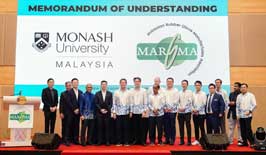
The Malaysian Rubber Glove Manufacturers Association (MARGMA) and Monash University Malaysia have formalised a partnership aimed at strengthening talent development, research collaboration and innovation within Malaysia’s rubber glove industry.
The collaboration will bridge the gap between academic research and industrial application by developing specialised education programs, advancing workforce upskilling and establishing a structured talent pipeline to support the industry’s future growth.
As the world’s leading producer and exporter of rubber gloves, Malaysia recorded export earnings of approximately RM14 billion in 2025. With increasing global competition and evolving technological demands, the partnership aims to help the industry move further up the value chain by integrating advanced academic research with practical manufacturing expertise.
“This partnership marks an important step in strengthening collaboration between industry and academia, creating meaningful benefits for both MARGMA members and the university’s students,” said MARGMA President, Oon Kim Hung. “While Malaysia leads the world in glove production, more than 80% of R&D roles in this sector are currently filled by non-specialists. This initiative is designed to help close that gap and build deeper technical expertise within the industry.”
The first major initiative under the MoU will be the co-development of a specialised Master’s degree program in Colloids and Latex Technology, designed specifically for professionals and engineers working in the rubber glove ecosystem.
Moving beyond traditional “trial-and-error” manufacturing approaches, the program will equip participants with advanced expertise in colloid science, latex fundamentals, nanotechnology, advanced characterisation techniques, applied artificial intelligence, industrial statistics and sustainable manufacturing practices.
Beyond education, the MoU focuses on strategic impact and global competitiveness by enabling manufacturers to translate scientific knowledge into practical operational improvements. Key expected outcomes include:
- Higher first-pass yields and lower defect rates
- Reduced operating costs through improved process optimisation
- Stronger in-house R&D capabilities to address increasing regional competition
Under the agreement, both parties will collaborate on several high-impact initiatives designed to strengthen industry-academia integration. These include the development of an industry-led curriculum, with MARGMA experts participating in academic advisory committees to ensure program relevance and global employability standards.
To support continuous professional development within the industry, the partnership will also introduce co-branded executive training modules and professional workshops aimed at upskilling engineers, technologists and industry professionals.
In addition, a structured talent pipeline will be established through annual intake targets for sponsored candidates from MARGMA member companies. Students will also undergo industrial training and final-year research projects within participating member facilities, providing valuable real-world exposure.
Industry leaders are encouraged to support this initiative through collaboration, sponsorship and talent development pathways.