
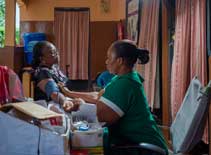
Almost 1,800 rubber farmers and their households, mostly children, in Côte d’Ivoire will benefit from a healthcare programme launched by the Global Platform for Sustainable Natural Rubber (GPSNR), which has tied up in a three-year partnership with Berlin-based social enterprise Elucid. This will benefit approximately 9,000 individuals.
The initiative is funded through GPSNR’s Shared Investment Mechanism (SIM) by 13 tyre and rubber companies: Aeolus Tyre Co., Ltd., Apollo Tyres Ltd., Balkrishna Industries Ltd. (BKT), The Goodyear Tire & Rubber Company, Hankook Tire & Technology, Kumho Tire Co., Inc., Maxxis International, Nokian Tyres plc, Prometeon Tyre Group, Sumitomo Riko Company Limited, Sumitomo Rubber Industries, Ltd., Toyo Tire Corporation, and The Yokohama Rubber Co., Ltd.
The partnership addresses a gap the industry has long overlooked: the direct impact of farmer health on supply chain productivity. Medical emergencies cost Côte d’Ivoire an estimated US$853 million in cocoa exports in 2017 alone. With many farmers cultivating both cocoa and rubber, the implications for the natural rubber sector are significant. Research from Ghana shows that enrollment of farmer households in national health insurance increases their agricultural investment in several areas by approximately 40%, according to a 2024 study published in Agricultural Finance Review.
Côte d’Ivoire is critical to global rubber supply chains, yet smallholder farmers who drive production across the country’s forest regions face severe healthcare barriers. The country ranks 187th out of 195 globally for quality of care, and only 32% of essential medicines are available in the public health sector, according to a 2020 health systems assessment. While two-thirds of the population are enrolled in the national health insurance scheme (CMU) on paper, fewer than 4% actually used their insurance card in 2025, due to administrative hurdles and facility-level barriers.
When farmers lack reliable healthcare, medical emergencies force them to sell assets and abandon farm improvements — a direct risk to the supply chains that depend on them.
The initiative combines four components:
. Enrollment in CMU national insurance for all participating farmers and households
. Elucid’s emergency and essential care scheme covering WHO-accredited medications and life-saving services
. Quality improvements at 15 healthcare facilities serving the target communities
. Community awareness programs connecting health to economic wellbeing
Elucid’s digital platform will track all data in real time, enabling transparent impact reporting throughout the project. The program aims to increase healthcare visits from fewer than 200 to over 1,800, drive CMU enrollment from less than 30% to over 90%, and prevent more than 150 catastrophic health expenditure events each year. Half of beneficiaries will be women and 20% will be children under 18.
Farmer enrollment begins in August 2026, with healthcare access improvements continuing until January 2029. From December 2027, the project will transition toward long-term sustainability, building cooperative capacity to maintain health support for their members.